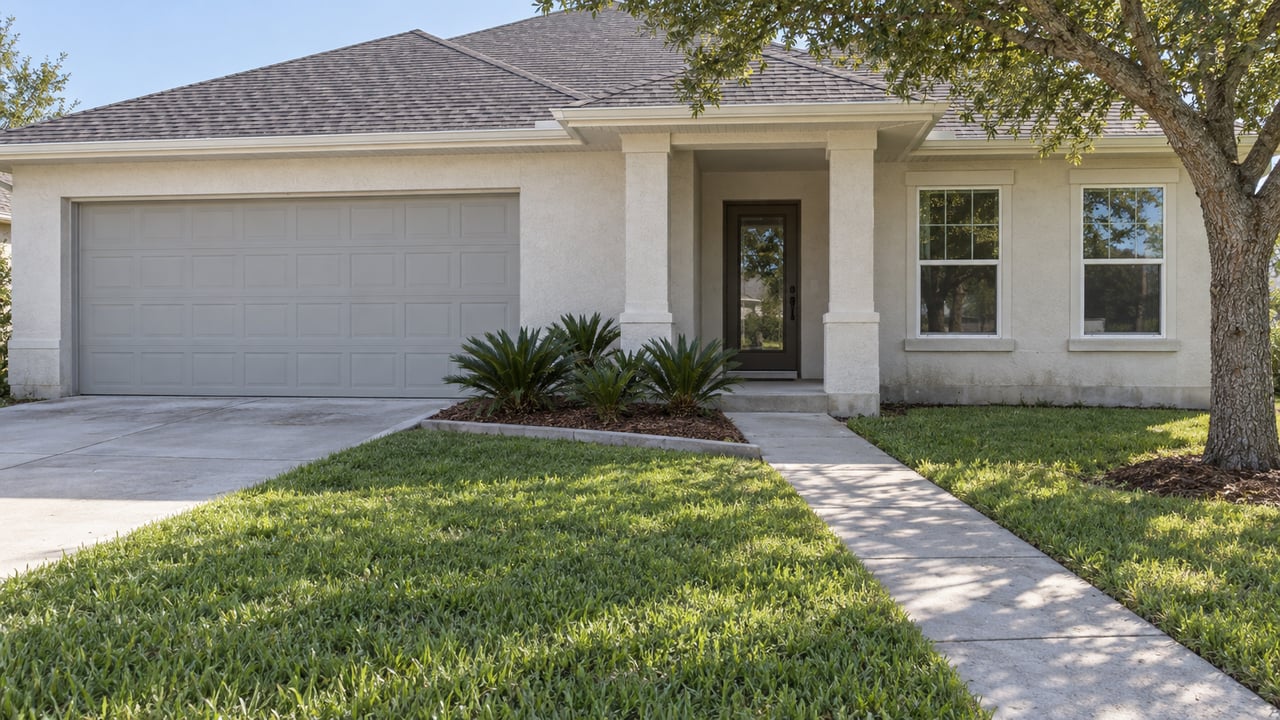
Wesley Chapel's 3.25% Builder Rate Runs Into VA's 4% Limit Faster Than the Ads Suggest
October 15, 2026
October 15, 2026
A VA buyer touring new construction in Wesley Chapel this October will see two kinds of numbers on the builder pages. The first is a rate. M/I Homes is advertising a 2/1 buydown on a 30-year fixed VA loan: 3.25% in year one, 4.25% in year two and 5.25% for years three through thirty, with a 5.808% APR on its example loan. The second is a dollar figure, such as "up to $20,000 in paid closing costs" or "50% off select upgrades."
Both numbers pass through a rule VA wrote for exactly this situation. VA's lender guidance says, in its own words, that "in some localities, builders or sellers offer concessions as a competitive tool," and it limits what counts as a concession to 4% of the home's established reasonable value. The rate buydown fills most of that 4% before any other incentive gets a turn. The advertised packages also assume you use the builder's own lender. For a VA buyer comparing a new build with a resale, those two facts shape the deal more than any line on the flyer.
The rule lives in Chapter 8 of VA Pamphlet 26-7, last updated July 9, 2026. VA defines a concession as anything of value the builder or seller adds that the buyer pays nothing extra for and that the seller isn't customarily expected to pay. The pamphlet then splits builder money into two groups:
| Counts toward the 4% limit | Does not count |
|---|---|
| Paying the buyer's VA funding fee | Paying the buyer's closing costs |
| Prepaying the buyer's property taxes and insurance | Discount points that are normal for the market |
| Gifts, such as appliances | |
| Escrowed funds for a temporary rate buydown | |
| Extra points for a permanent buydown, beyond what the market calls for | |
| Paying off the buyer's credit balances or judgments |
VA's own example shows where the line falls on points. If the market calls for two points and the seller pays five, the three extra points are a concession.
The table puts the most popular incentive this fall, the 2/1 buydown, on the "counts" side. Ordinary closing costs sit on the side that doesn't count, so a builder can pay them without touching the limit.
M/I Homes lists Chapel Crossings, on Newberry Pines Avenue in Wesley Chapel 33545, among the communities eligible for its rate promotion. The fine print bases its VA example on a $411,000 sales price, with $424,563 financed including the VA funding fee. The offer applies to select Quick Move-In homes on new contracts written on or after September 14, 2026. The loan application is due within 48 hours of signing, and closing has to happen by December 31, 2026.
VA measures the limit against the home's established reasonable value, not the sales price itself. If the reasonable value matched the $411,000 example price, 4% would be $16,440. That would be the ceiling for everything in the left column of the table above.
Next comes the buydown itself. On M/I's example figures, principal and interest work out to roughly $1,848 a month at 3.25%, $2,089 at 4.25% and $2,345 at 5.25%. Covering the gap for two years takes roughly $9,000. That is our estimate from M/I's example loan, not a figure M/I publishes, and the real escrow amount will be on the lender's paperwork. Even so, the estimate shows the buydown alone uses more than half of the $16,440.
That leaves about $7,400 for everything else in that column. Two items stand out in M/I's terms:
M/I's own wording reflects this. Its rate offer says the seller's contribution "is limited to agency limits, which depend on the loan program and LTV." Its sale event puts those limits at 3% to 6%, depending on the down payment and loan program. The Home Sweet Savings page also says that offer "may not be combined with other offers or incentives," and it doesn't say whether VA loans are eligible. A buyer hoping to pair the VA buydown with upgrade savings and a $20,000 closing credit needs the builder's answer on combining them in writing.
VA's Chapter 7 requires the lender to qualify the borrower at the full payment due after the buydown ends. The buydown money sits in a separate escrow that can only be used for payments under the note. On M/I's example, the payment the lender tests your income against is the 5.25% payment, not the 3.25% one.
That 5.25% is still far below the broader market. Freddie Mac's survey put the average 30-year fixed at 7.40% as of October 8, 2026, compared with 6.30% a year earlier. Freddie Mac measures conventional loans with 20% down and excellent credit, so its average isn't a direct VA comparison. The years-three-through-thirty rate is where most of the value in the offer sits. The first two years are the part that uses up the 4%.
The APR is another useful check. Lennar's Tampa-area Fall Super Sale, which named move-in-ready homes in Wesley Chapel's Twinflowers, advertised an FHA 5/1 ARM at 3.99% with a 5.867% APR. The fine print says that APR was "achieved by Lennar paid discount points" and required financing through Lennar Mortgage. That contract window ran from October 8 to October 11, 2026, so the offer has closed. It still shows the pattern. The bigger the gap between a builder's advertised rate and its APR, the more the builder paid up front to get there. Under VA rules, any points beyond what the market calls for count toward the 4%.
Every M/I offer mentioned here runs through M/I Financial, LLC. The Home Sweet Savings terms describe what happens if you use someone else. With M/I Financial, 3% of the base purchase price goes toward closing costs. With a different lender, M/I covers "the remaining portion of the total closing cost assistance, excluding the affiliate incentive amount." The rate offer also isn't guaranteed until it's locked with M/I Financial.
The federal rule behind arrangements like this is RESPA's affiliated business provision, which the CFPB administers as Regulation X, Section 1024.15. It requires written disclosure of the affiliation and the estimated charges, and it bars requiring the buyer to use the affiliated provider. Under the definitions in Section 1024.2, a package or discount isn't "required use" if it's optional, a true discount below generally available prices, and not offset by higher costs elsewhere. In practice, a buyer can usually choose a different lender. The incentive is just smaller if they do.
That's why a fair comparison takes two Loan Estimates for the same house, one from the builder's lender and one from an outside VA lender. Line them up against the incentive each one actually unlocks.
The list of VA concessions doesn't include a lower purchase price. That matters this fall, because some builders are cutting prices along with their rate offers. D.R. Horton's Mirada, a Pasco County community the builder places in San Antonio, showed a four-bedroom, 2.5-bath, 2,045-square-foot home at 11117 Cotton Vale Pl for $420,000, down from $443,240, under a "Big home savings" banner ending November 1. Lennar's fall promotion offered up to $25,000 off select homes.
Resale sellers fall under the same 4% rule as builders, but most of them can't offer a below-market rate through an in-house lender. What they can do is negotiate price, and the county numbers suggest buyers have room. The Pasco County report for August 2026 showed single-family homes selling for a median 96.5% of original list price, with a median of 43 days to contract. The county had 3,307 active listings and 4.3 months of supply, and the median sale price was $383,745, nearly flat from a year earlier. These are countywide figures, not Wesley Chapel alone. September numbers are scheduled for release on October 16, 2026.
For a VA buyer, a resale with a negotiated price and seller-paid closing costs keeps the full 4% available for other concessions. A builder home with a buydown has already used much of it. Both can be the right choice, but they spend the limit differently.
VA lists escrowed funds for temporary buydowns as a seller concession.
VA allows hybrid ARMs with initial fixed periods of 3, 5, 7 or 10 years. For hybrids fixed at least five years, the first adjustment is capped at 2 percentage points and the lifetime increase at 6.
Payment of the buyer's closing costs is excluded from the limit, while prepaid taxes and insurance are included.
This post is general information about how VA and RESPA rules work, not legal, tax or financial advice. Please confirm the details of your own loan and contract with your lender and the appropriate professional.
I've used my own VA benefit and spent years as a military spouse, so I know how much rides on getting the numbers right before you sign. If you're weighing a Wesley Chapel builder offer against a resale and want help laying out what each one actually leaves you with, Karena Caputo is glad to go through it with you. Let's Connect.
Stay up to date on the latest real estate trends.
Every client deserves honest communication, strategic guidance, and dedicated representation. Experience a real estate partnership focused on achieving your goals with confidence.
KARENA CAPUTO
2234 LITHIA CENTER LN VALRICO, FL 33596